
Understanding Blood Glucose Patterns Without Self-Diagnosis
Learn why glucose trends, meal timing, and clear records matter—and what blood glucose logs can and cannot tell you.
Understanding Blood Glucose Patterns Without Self-Diagnosis
A blood glucose reading can be useful, but it is only one piece of information. The number may change depending on when you last ate, your activity, medication, sleep, stress, illness, and other factors. Looking at several readings alongside their circumstances can help you prepare better questions for your healthcare professional. It cannot, by itself, tell you whether you have a condition or which treatment you need.
This guide explains how to look at patterns without turning a glucose log into a self-diagnosis tool.
One reading is a snapshot; a pattern adds context
Imagine checking your glucose once after a meal and seeing a result that surprises you. Without knowing what you ate, when you checked, whether you were unwell, or what your usual readings look like, it is difficult to interpret that number.
A log collected over time can reveal repeated situations worth discussing. For example, you might notice that readings taken at a similar time of day tend to differ from readings taken at other times. That observation is a starting point for a conversation—not proof of a particular medical problem.
A few readings do not necessarily represent a stable trend. Meters and sensors also have limitations, and recording errors can occur. If a result seems inconsistent with how you feel, follow the instructions for your device and your clinician's care plan rather than drawing a conclusion from the number alone.
Why fasting and post-meal context matters
Fasting readings are generally taken after a period without calories, often in the morning. Post-meal readings are taken after eating, but their meaning depends partly on how much time has passed since the meal. The timing recommended for you may differ from someone else's.
When logging a reading, try to include:
- The date and time.
- Whether it was fasting, before a meal, or after a meal.
- If after a meal, the approximate time since eating.
- Relevant context, such as unusual activity, illness, or symptoms.
- Medication information only as directed in your care plan.
These notes make it easier to compare similar situations. A fasting reading and a reading soon after eating should not be treated as interchangeable measurements. Likewise, a single post-meal result should not be used to label a food as universally “good” or “bad.”
What a glucose log can show
A well-kept log can help you and your care team notice recurring observations, such as readings that appear different at certain times of day or after particular routines. It can also make appointments more productive because you do not have to rely on memory.
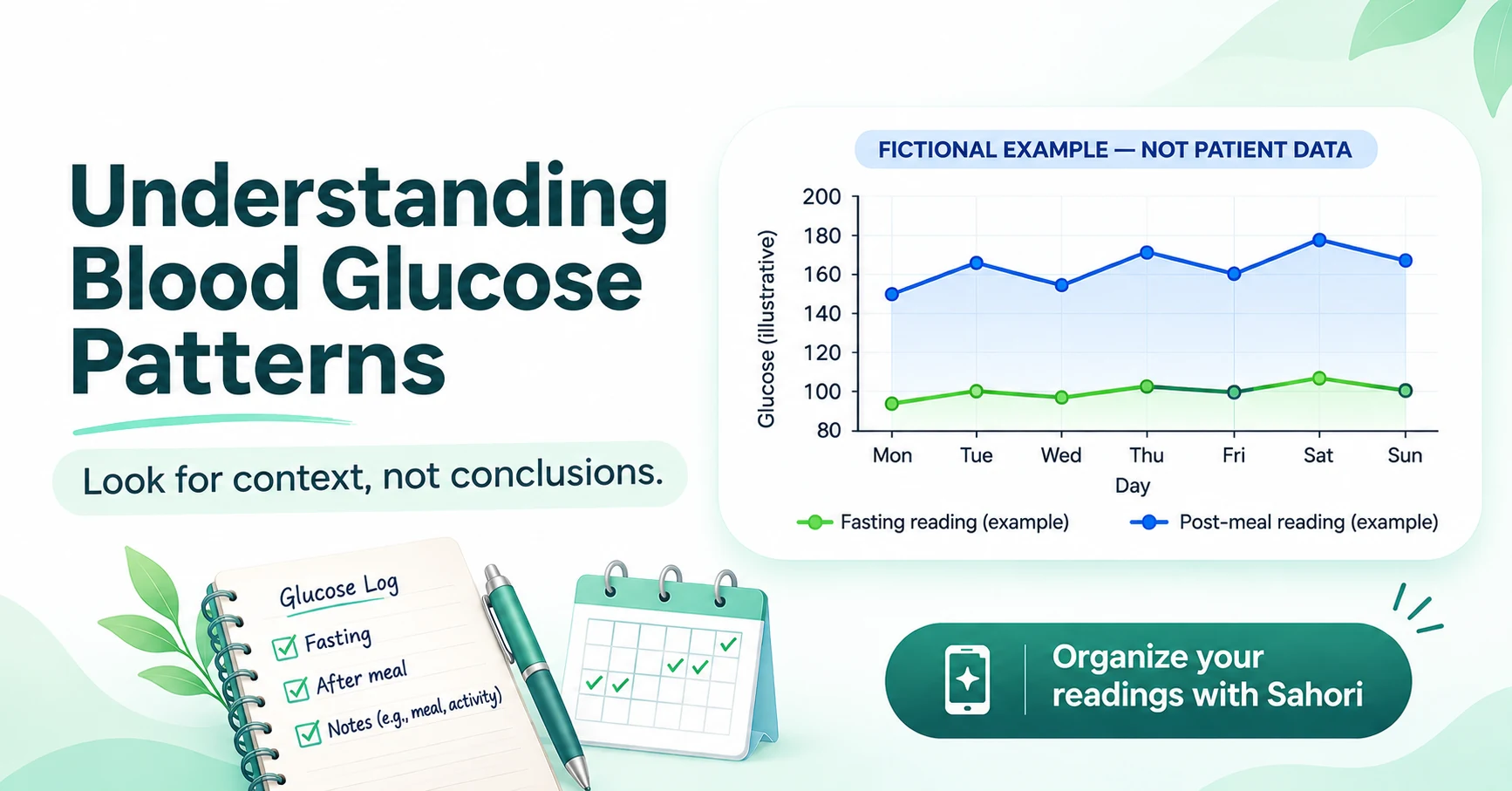
For example, consider a fictional seven-day chart showing a series of morning and after-meal readings. If the after-meal line is often above the morning line, that alone does not establish whether either set of readings is healthy or unhealthy. It simply shows that readings taken in different contexts differ. A clinician can interpret the information using your health history, goals, medications, symptoms, and any appropriate laboratory tests.
Illustration note: Any chart accompanying this article uses invented values solely to demonstrate how a log can display readings. It is not a patient record, recommended target, or diagnostic threshold.
What a glucose log cannot tell you
Home glucose readings are not a substitute for a medical evaluation. A log alone cannot reliably:
- Diagnose diabetes, prediabetes, or another condition.
- Explain the cause of an unusual reading.
- Determine whether a medication should be started, stopped, or changed.
- Establish an appropriate glucose target for every person.
- Replace recommended laboratory testing or follow-up visits.
Diagnosis usually requires specific clinical tests and interpretation by a qualified healthcare professional. Targets and monitoring schedules may vary based on age, health conditions, treatment, pregnancy, and other individual factors.
Avoid changing insulin doses or other medicines based only on a trend you noticed in an app or spreadsheet. Follow your prescribed plan, and contact your care team when you are unsure what to do.
How to make your log more useful
Consistency often matters more than collecting as many numbers as possible. Ask your clinician when and how often you should check. Then try to record readings in the same way each time, including meal timing when relevant.
Keep the record straightforward. A date, reading, unit, and short note may be enough to start. If you use a glucose meter or continuous glucose monitor, understand which type of measurement it provides and follow its instructions. Do not compare measurements from different methods as though they were identical without professional guidance.
If you miss a reading, do not invent one to fill the gap. A log with a few honest gaps is more useful than a complete-looking record that is inaccurate. If another person helps manage your care, discuss what information you are comfortable sharing.
Questions to bring to your next appointment
You do not need to interpret every number before seeing your clinician. Instead, bring the log and ask practical questions:
- Which readings should I focus on, and when should I measure them?
- Are there patterns in my log that you want to investigate?
- What context should I record alongside a reading?
- What are my individualized glucose goals, if monitoring is appropriate for me?
- What should I do if a reading is unexpectedly high or low?
- When should I contact your office, and when should I seek urgent help?
If you have symptoms, mention them even when your recorded numbers seem unremarkable. Your experience matters alongside the data.
When to seek urgent medical care
Do not wait to collect more readings if you have potentially serious symptoms. Seek emergency medical help immediately for fainting, seizures, severe confusion, inability to swallow safely, or loss of consciousness. These can be emergencies regardless of what a device shows.
Urgent assessment is also important for symptoms such as persistent vomiting, severe dehydration, difficulty breathing, or unusual drowsiness, particularly when glucose readings are concerning or you have diabetes. If you have a prescribed plan for low or high glucose, follow it and seek help as instructed. Never give food or drink to someone who is unconscious or unable to swallow safely.
For a reading that is unexpected but without emergency symptoms, follow your clinician's instructions and your device's guidance on rechecking and contacting your care team. If you are uncertain, seek medical advice rather than relying on an online article.
Organize readings for better conversations
A glucose log is most valuable when it supports understanding and communication. It can help you remember what happened, spot questions worth asking, and share clearer information at appointments. It should not make diagnoses or treatment decisions on your behalf.
With Sahori, you can organize blood glucose readings and keep relevant health information together. Use your records to prepare for conversations with a qualified healthcare professional—one reading and one question at a time.
For step-by-step app instructions, see how to log blood glucose in Sahori.
Explore Sahori's Diabetes Care features to make everyday tracking easier.
References and further reading
- American Diabetes Association. Diagnosis. https://diabetes.org/about-diabetes/diagnosis
- U.S. Centers for Disease Control and Prevention. Monitoring Your Blood Sugar. https://www.cdc.gov/diabetes/treatment/monitoring-blood-sugar.html
- National Institute of Diabetes and Digestive and Kidney Diseases (NIDDK). Diabetes Tests & Diagnosis. https://www.niddk.nih.gov/health-information/diabetes/overview/tests-diagnosis
- CDC. Diabetic Ketoacidosis. https://www.cdc.gov/diabetes/about/diabetic-ketoacidosis.html
Medical information disclaimer: This article is for general education and does not provide diagnosis, personalized glucose targets, or treatment advice. Consult a qualified healthcare professional for guidance specific to you. Clinical review is required before publication.